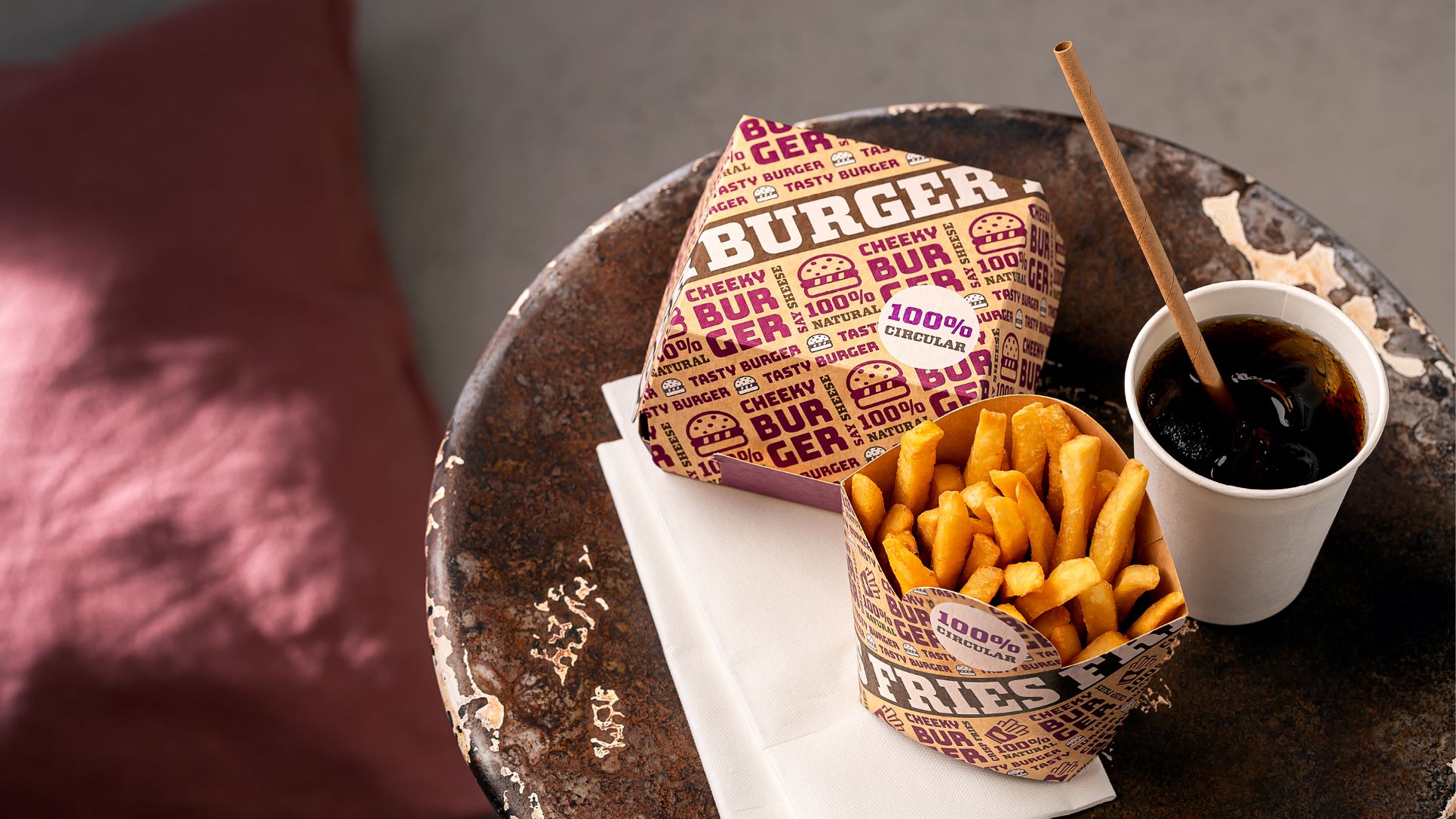
For Swedish converter Aristo, these practical considerations guided the search for a board solution that could deliver dependable performance in both packaging applications and converting operations. Together with Stora Enso, the company began evaluating dispersion-coated board as an alternative to PE materials.
From converting challenges to reliable performance
Aristo introduced its delibox concept in 2018, targeting the growing market for takeaway meals, salads, sushi, and more. At the time, achieving grease resistance required applying an external lacquer layer to the board surface. The approach worked in principle, but the lacquered material was challenging to convert and resulted in high material losses during production.
Reflecting on the early development of the concept, Dan Möller, Sales Manager at Aristo, explained: “The early challenge was to find a board quality with the right functionality that worked well in our converting line, while also being a locally produced kraft board with an alternative coating to traditional PE.”
In 2020, Stora Enso introduced CKB Nude Aqua, a brown multilayer kraft back board with a thin dispersion coating on one side. Designed for grease-resistant folded packaging applications, the board provided Aristo with a new option to test against its operational requirements.
Aristo adopted the material early and has since implemented it across several foodservice packaging formats.
Grease resistance without traditional plastic layers
CKB Nude Aqua combines unbleached chemical pulp with chemi-thermomechanical pulp (CTMP) in the middle layer, a structure designed to provide the stiffness and strength required for stable folded packaging. A thin dispersion coating on one side provides grease resistance. The board can hold dry and fatty food up to 90°C for up to two hours, making it suitable for applications such as clamshell boxes, takeaway packaging, fresh produce trays, and selected frozen food formats.
For converters, the more decisive question is how the material behaves in production. CKB Nude Aqua is optimized for folded packaging and can be sealed using conventional gluing methods. Aristo also points to the strength of the board as an important factor when forming stable packaging structures at lower grammages.
Explaining the material design behind these performance characteristics, Tomi Nurminen, Head of Product Line CKB at Stora Enso, said: “Our focus with CKB Nude Aqua was to combine grease resistance with the physical properties converters expect from high-performance board. The fiber structure and dispersion barrier are designed to provide stiffness, strength, and reliable runnability so converters can achieve stable packaging without changing their existing production processes.”
Discussing why the material works well in production, Möller noted: “CKB Nude Aqua has a smooth quality that runs well in our production and provides a nice surface for printing our customers’ logos. The board’s stiffness properties also help create stable and functional packaging solutions.”
Supporting circular packaging systems
Using a dispersion barrier instead of a conventional plastic layer allows a higher share of fibers to be recovered during the repulping process. This improves fiber yield when the packaging is recycled in standard paper and board recycling systems. CKB Nude Aqua has been evaluated according to CEPI recyclability test methods and the 4evergreen protocol. For grammages under 270 g/m2, Industrial compostability certification according to DIN EN 13432 is also available.
For Aristo’s customers, these material characteristics increasingly influence packaging decisions. Brand owners in the foodservice sector are reassessing packaging constructions as regulations evolve and extended producer responsibility (EPR) schemes place greater scrutiny on material composition.
Looking at broader market expectations, Möller explained: “Our main customers are brand owners in the food-to-go market. As the market continues to transition from plastic to cardboard, customers are developing new packaging constructions made from cardboard. The possibility to print the customer’s logotype and branding directly on the board is also a major advantage.”
He added: “Sustainability requirements and regulations, such as EUDR and PPWR, are also increasing expectations in the market and driving the need for packaging solutions that meet these standards.”

Proven in real foodservice applications
Today, Aristo supplies packaging solutions to a range of Nordic foodservice brands. In the transportation sector, the company produces breakfast packaging where inner compartments for vegetables are manufactured using CKB Nude Aqua. The material is also used in takeaway packaging formats such as sushi boxes.
Beyond foodservice, Aristo sees growing interest from grocery retailers introducing portion-packed ready-to-eat meals and fresh food concepts. These applications place similar demands on packaging: grease resistance, structural strength, and compatibility with high-speed converting processes.
The natural brown appearance of the board also supports packaging designs that emphasize an unbleached and more natural visual expression.

Expertise in material and converting
The collaboration between Aristo and Stora Enso underscores the relationship between material development and converting expertise. While converters ultimately determine whether a board performs on the production floor, material design plays an equally important role in enabling those outcomes.
Looking at broader industry developments, Nurminen added: “Across foodservice and retail applications, brand owners are developing new packaging concepts that rely on paperboard structures with effective grease barriers. Our role is to support converters with materials that allow those designs to be produced efficiently.”
In the case of CKB Nude Aqua, dispersion barrier technology combined with kraft board construction allowed Aristo to address the operational issues encountered with earlier lacquer-based solutions.
For converters and brand owners seeking grease-resistant food packaging that fits within existing recycling systems and production lines, the experience demonstrates how technical collaboration across the packaging value chain can turn a material innovation into a practical packaging solution.
Contact us for more in-depth assistance for your packaging materials questions.