We kick off our series by discussing circular design with one of our Packaging Designers, Eveliina Juuri. From concept to shelf, Eveliina works with sustainability and regulatory teams as well as other diverse experts across the organisation to create high-quality, functional cartonboard packaging that solves customer challenges.
One of Stora Enso’s objectives is to accelerate the transition to circular bioeconomy. How would you define circular bioeconomy and how can circular design contribute?
Circular bioeconomy is a closed-loop system where resources are continuously reused and recycled to minimise waste and environmental impact. Circular packaging design can contribute through the 4R principle: refuse, reduce, reuse, and recycle. We evaluate each step to see where we can avoid unnecessary use of materials, minimise waste, limit empty space and overpacking, enhance reuse, and ensure recyclability.
Recyclability is key for our products, and we design packaging so that it’s structurally and material-wise easy to recycle. For instance, it can fold easily or be made of one type of material, or “mono-material,” for easy sorting. With our deep expertise, we can also guide customers on how to communicate about recycling and sorting to consumers. Here, the package and design work as a communication medium.
How does the design process go? How do we meet customer and market needs?
The design process begins when a customer reaches out to us with a brief outlining their needs: it could be to create a completely new design, solve existing quality issues, or move from fossil-based materials to fibre-based packaging. Each solution is tailored to customer needs, whether it's lightweighting, improving functionality or durability, or enhancing user experience and shelf appearance.
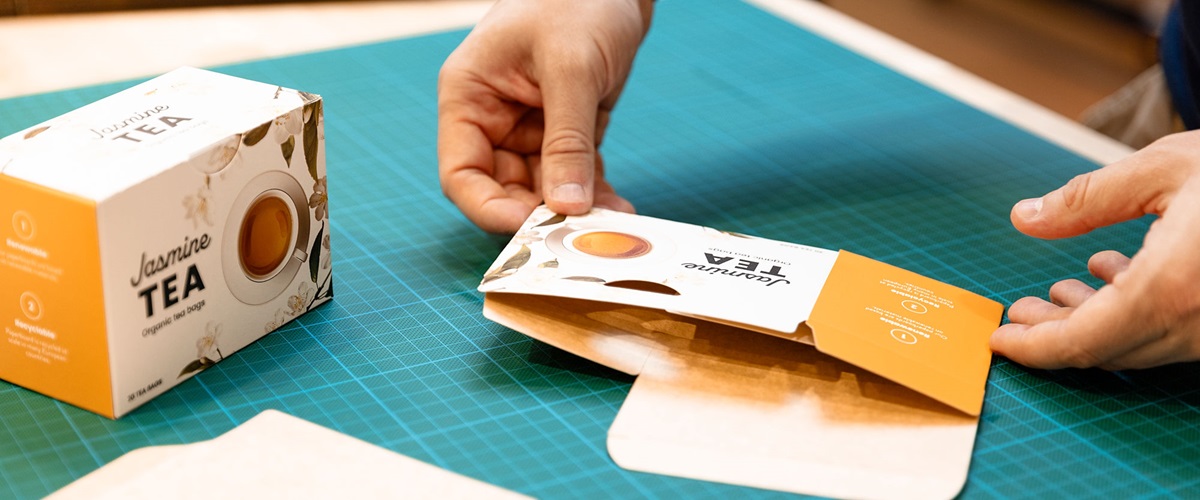
A typical design process contains preliminary market research, concept creation, material matching, structural and graphic design, prototyping and testing, compliance checking, hand-off to production and review rounds in between. With visual tools like 3D model renderings and tangible prototypes, we can effectively communicate the look-and-feel of the packaging to our customers: how it serves the purpose and aligns with the customer brand.
What are the elements of quality, high-performance packaging – and how can packaging be innovative?
High-performance packaging suits the purpose: it’s resource-efficient, functional, and easy to manufacture in high volumes and fast-paced production. Good design offers new approaches to make this happen. To solve customers’ packaging challenges, we introduce solutions like innovative opening mechanisms or structural designs that maintain strength while reducing weight. We focus on how packaging folds, tears, and holds up, ensuring durability, reliability, and safety. When moving from fossil-based materials to fibre, we also rethink how the packaging best adapts to the new material.
Ultimately, quality packaging is more than a box. It protects its contents, is designed for circularity, reflects the brand, and inspires us to reimagine what packaging can be.
How can the environmental impacts of packaging be optimised with design – such as recyclability or climate impact?
The most important goal is to balance sustainability with functionality. With the combined material expertise of our design and sustainability teams, we can offer choices that meet both business and sustainability goals. Material choices and smart structural design are key in impacting the carbon footprint and recyclability.
The journey of packaging goes beyond design, but with design we aim to consider the overall picture, like the printing process, the converting site, and even the consumer behaviour. As a company, we optimise the value chain from the forest to the final product. With this holistic approach, we can offer materials that help our customers meet their circularity and climate targets.


